
Art of Conversation

Art of Conversation is a video game design project for children with special educational needs and communication challenges.
Made possible with generous funding and support from Paul Hamlyn Foundation.

Aims:
- Encourage and inspire communication and collaboration between pupils, and between pupils and adults.
- Make and publish a calming therapeutic game that everyone can enjoy, with:
- trees
- flowers
- animals
- delightful sound effects
- pleasant music
- Use the making of this art to inspire the understanding of:
- shape and size
- colour
- number
- language
- music

Pupils will work together to create a magical world, with plants, rocks, animals and water.
As the player nears objects in the world, they will also play tunes that pupils will have created, and display visual effects such as falling leaves, bursting berries, floating seeds, and so on.
The aim is for players to become immersed in a serene world that offers a therapeutic experience.
This world will have been built collaboratively by the pupils of both schools – giving them genuine authorship that they can be proud of and that we can celebrate together.
We will be publishing this as a game anyone can play for free.
Pupils will work in groups of up to 6, gathered around a large screen. They will be presented with a virtually empty island island in which to create their world.
The world will be based on a square grid. There will be a first-person player that pupils will move to each square in turn.
 The large screen will show a menu for pupils to choose which way to go.
They will choose by voting with ChoiceBoxes – bespoke designed hand-held devices which we will create using Micro:Bits.
 Each pupil will be given their own ChoiceBox, and they will register their choice by pressing a coloured button. A small screen on each device will display the name of who in their group has voted in the same way that they have. They will then have an opportunity to compare and discuss, and then possibly change their minds. This will stimulate and help to structure a conversation, held each time between the group, about how to proceed.
Once the consensus is reached, the result will be locked in and a nominated pupil from the group will step forward to press the winning colour. This will send a signal to the computer, which will instruct the player to move to an adjacent square.
If there is no content in the square, participants will get another color menu on screen to vote on what sort of thing to put in the square: plant, animal, rock, or water:
 From here participants will drill down, choosing the detail of what they, as a group, would like to see. For example:
- Plant:
- Tree
- Grass
- Flower
- Berries
- Flower:
- How many
- 1
- 2
- 3
- 4
- Colour
- Red
- Green
- Yellow
- Blue
- Effects
- None
- Floating pollen
- Falling petals
- Swarming bees
- Music
- None
- Tune 1
- Tune 2
- Tune 3
- How many
These choices and the level of detail will be differentiated to accommodate the needs of the pupils. For example, if pupils struggle with too much choice, some of the details may be automated randomly. Similarly, the onscreen menus can be pictures or words. For more advanced pupils we might use larger number ranges, such as: 1-5, 6-10, 11-20, 21-30
The music will be created in separate workshops.
We will use a Tetratonic Major Scale (C – D – E – G), a simple and accessible four-note scale found in various musical traditions across the world. This scale allows children to easily create pleasing and harmonious melodies that fit the style of the world we’re building.
We will assign musical registers to elements of the world:
- 2 octaves below middle C for rocks
- 1 octave below middle C for trees
- 1 octave above middle C for bunnies
- 2 octaves above middle C for flowers
Children will sit in a row and take turns pressing a colored button to contribute a notes to the composition.
 When they do, a note will play. We will use play and experimentation to find tunes we like. Pupils will be encouraged to finish their tunes by returning back to Red-C.
We will also use voting to choose which tune to use in each location.
At any time, pupils will be able to use the same devices to explore the artistically rich virtual world that they are creating together. The same four colours will act as their means of navigating: forwards, backwards, turn left, turn right.

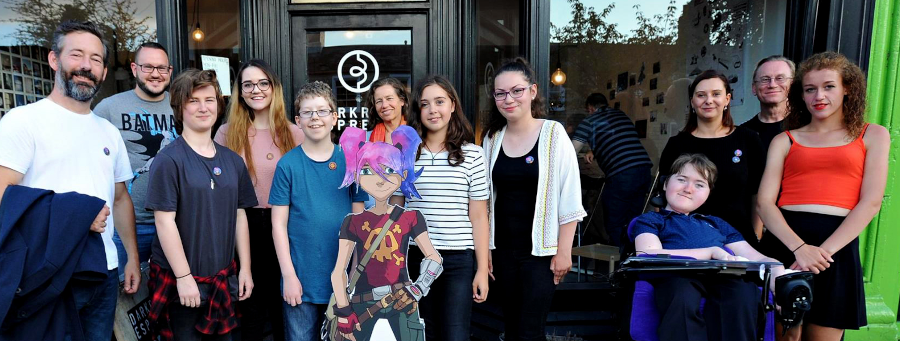
The pupils we are working with have a range of needs and disabilities, including:
- Profound and Multiple Learning Difficulties (PMLD)
- Mild to severe learning difficulties
- Non-verbal
- A range of physical and sensory disabilities
They will benefit from using alternative means of communication and tailored ICT equipment to enhance their engagement, communication, and learning opportunities. For these pupils communication presents a particular challenge.
In Art of Conversation, students will take part in a programme created specifically for them, which empowers them to be creative and allows them to communicate through the medium of ICT. Furthermore, overall, the engagement will support developmental engagement understanding, from supporting the youngest to the older children.
Art of Conversation will:
- Empower them by providing access to innovative ICT tools that promote independence, communication, and engagement in learning.
- Foster an inclusive environment where their unique needs are met using adaptive technology.
- Allow students to be able to voice and participate in the project and for them to feel valued and part of the project.
- Enjoy stronger relationships with their teachers and each other by using ICT to bridge communication gaps and engage in more personalised learning experiences.
Art of Conversation is completely FREE – no charges for participation during school hours or in after-school sessions.
Art of Conversation includes free CPD sessions for teachers and TAs as part of the project — covering:
- 3D modelling
- Game design
- Physical computing
- Use of ChoiceBoxes in other lessons and activities.
We understand how busy schools are — so we make everything as simple as possible for you.
We’ll take care of:
- All parental consent forms
- Risk assessments
- Planning and delivering all sessions
- Providing any equipment needed
There’s no cost to schools, and minimal admin required on your part.
All we need is space and some deserving students.
Safeguarding is at the heart of everything we do.
- All tutors have Enhanced DBS checks (Child Workforce)
- Lead tutors are qualified teachers with Level 3 Safeguarding Training
- We follow robust safeguarding policies and procedures in line with current legislation
- Our team has experience working with children from a wide range of backgrounds and needs
Your staff are always welcome to observe or attend sessions.
You can download our full Safeguarding Policy here (PDF) for full details.
I am text block. Click edit button to change this text. Lorem ipsum dolor sit amet, consectetur adipiscing elit. Ut elit tellus, luctus nec ullamcorper mattis, pulvinar dapibus leo.